Build your
Formula 1 legend
Sign drivers from any era, run your own team, take on daily challenges and let the engine settle who is really the greatest of all time.
Your F1 career · long games

Driver career
The Racing Line
Twelve years old and a kart. Climb F4, F3 and F2, choose between offers from real teams and earn a seat against the real grid.
Start in karting →
Team principal
Manager
Create your team: sign drivers, build parts and write the strategy for every Grand Prix, then watch it race lap by lap.
Create your team →What we have measured
All articlesEvery piece here comes out of our own simulator: thousands of seasons re-run to answer a question, with the method written down. And whatever you read, you can go and run yourself.
Latest · 4 minAustin is the circuit where pole position is least likely to survive lap one
Since 2012 the polesitter in Austin has lost the lead on the first lap 7 times out of 13. No other circuit on the calendar comes close: across F1, pole is still in front after lap one in three races out of four. In the last five editions it held on only once, and the driver starting second has won 38% of the races in Austin, against 24% everywhere else.
- 5 minCan Antonelli win the F1 title in Austin? What he needs and what 1,000 simulations say
- 7 minF1 win records: overall, in a season, in a row and at the same circuit
- 6 minThe youngest drivers in F1: to start a race, take pole, stand on the podium and win
- 6 minNobody has won on all six continents: the four drivers who can be first when F1 returns to Africa
- 8 minF1 returns to Africa in Rwanda: the 24 races it already ran there, from Casablanca to Kyalami
- 5 minRussell starts last in Singapore: what Marina Bay gives from the back and when Antonelli can be champion
Minigames · a new puzzle every day
All →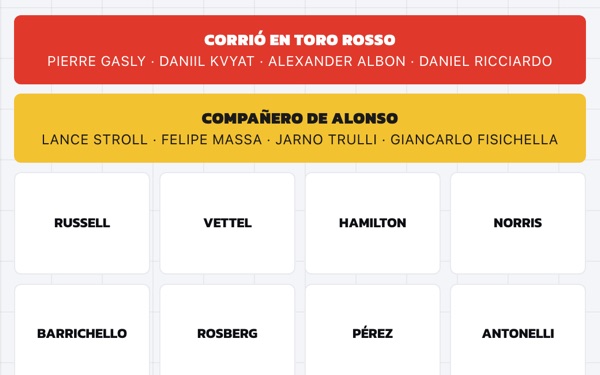
Four Garages
Sixteen drivers, four hidden groups
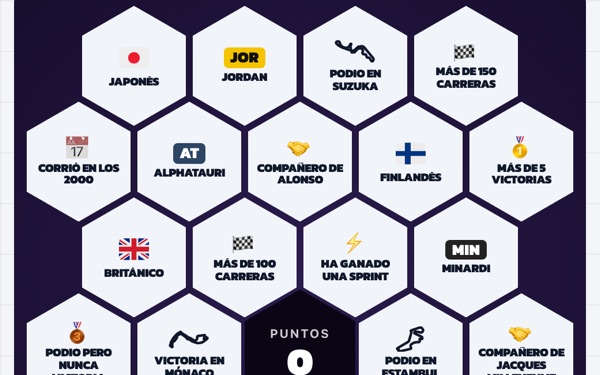
GrillHeat
Fill the honeycomb with drivers who fit
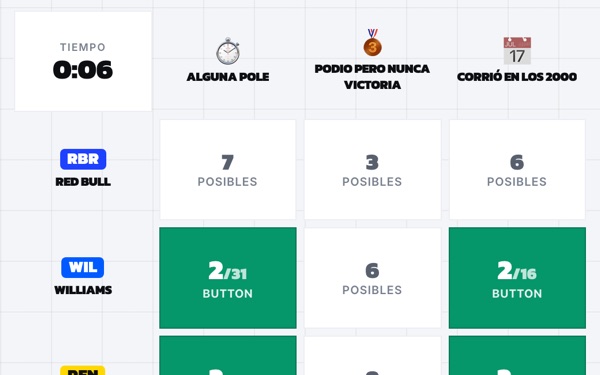
Box Box
Formula 1 tic-tac-toe
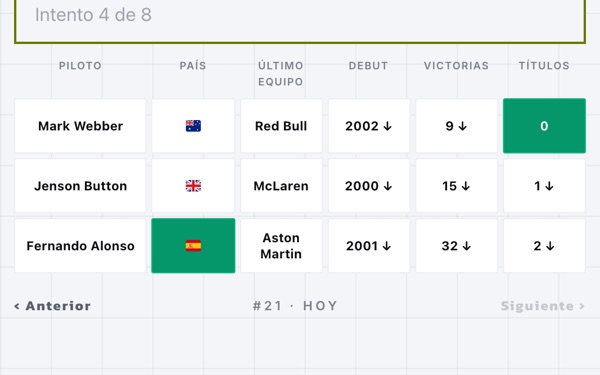
Who Is It?
Guess the driver in eight tries
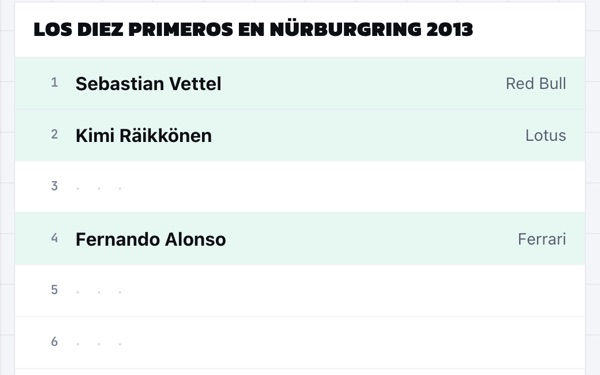
The Ten
Complete a list of ten
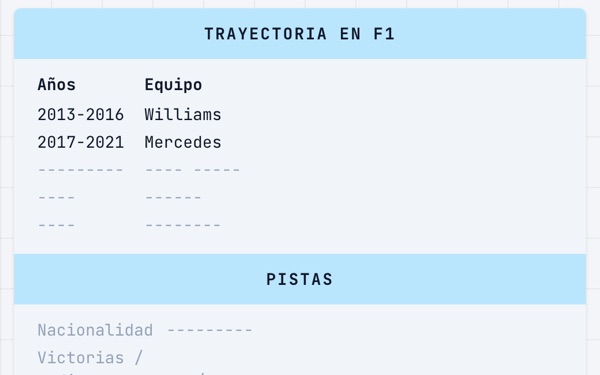
Track Record
Who is it? You only see his teams
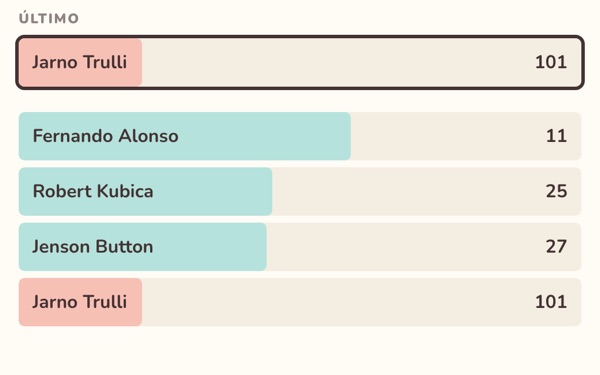
Apex Secret
Hot or cold with a secret driver
Seven games
All the minigames
How each one works and the previous puzzles →
More ways to play
Roulette
The quickest way in: the machine draws you two drivers, a season and a car, and the engine races the season. One sitting, no account.
The Pit Wall
You do not drive: you decide. Winter market, then the season runs race by race and stops at three weekends where the call is yours. Results, board and locker room pull in different directions.
Streak Mode
Best-of-three duels with identical cars. Every rival is better than the last: lose one and it is over. Retire when you dare and bank the streak.
What If?
What if Senna raced in 2023? Free choice of drivers, season and team, with Monte Carlo.
Garage Mode
Build a dream team across eras: pick drivers, car, principal and engineer one at a time: the rest re-draw.
Multiplayer
Draft with friends: each player builds a team from any era, one slot at a time. Race a tournament together.
Daily Challenge
Same challenge for everyone: build a team with your budget, invest in the car, pick staff, nail the pit-stop minigame and run a 10-race mini-championship.
Predict the GP
A daily fantasy grid: 20 random drivers and cars from any era. Order your top 10; the engine simulates the race and scores how close you were. Same challenge for everyone.
Daily Manager
A daily mini-manager, the same for everyone: allocate car development, pick your risk strategy and decide the dilemmas. The engine runs 6 GPs with a fixed seed: best decisions win.
New to The Racing Line? How the F1 career game works → · Daily puzzles? The F1 minigames →
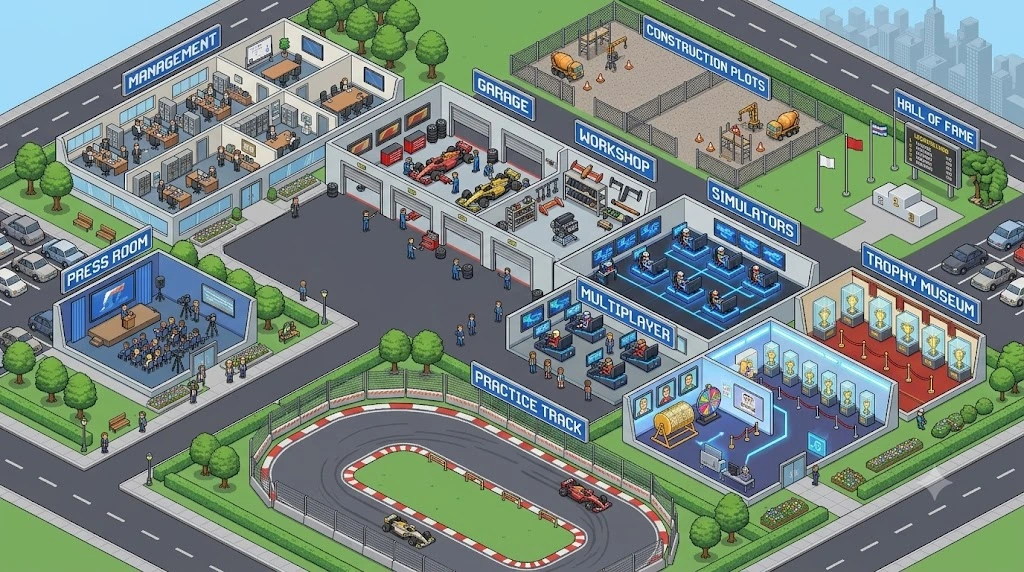
Your paddock
Gear and the daily shop
Everything you play earns Legend Points. Spend them on helmets, suits and liveries in a shop that changes every day, and your achievements go into the trophy museum.
Go to the paddock →Legendary duels
The scenarios everyone wonders about. One tap and the engine settles it.
Hamilton in the 2023 Red Bull
The car that won 21 of 22
Senna vs Schumacher, 1994
The duel fate cut short
Verstappen in the 2021 Mercedes
Would he still have won?
Alonso in the 2010 Red Bull
The title that slipped away
Prost vs Senna, 1988
Teammates and rivals at McLaren
Hamilton vs Verstappen, equal cars
No excuses: pure talent
What is F1 Legend Sim?
F1 Legend Sim is a free Formula 1 simulator. It answers the questions every fan has argued about at some point: what if Ayrton Senna had driven the 2023 Red Bull? Would Lewis Hamilton have taken an eighth title at Ferrari? How would Schumacher and Verstappen compare in the same car? You pick the drivers, the car and the season, and the engine runs the whole championship.
The database covers 38 seasons, from 1988 to 2026, with the real grid of every year plus legends from earlier eras. Each driver carries seven attributes (overtaking, cornering, braking, reactions, one-lap pace, aggression and consistency), and each team a car performance and a reliability figure. Those values come from comparing thousands of simulated seasons against the real results in Ergast and Jolpica, and correcting them until they line up. There is no machine learning here: it is weighted formulas, gaussian noise and a calibration loop.
Every race simulates qualifying, the full field of rivals, the weather, tyre degradation across a stint, pit strategy, mechanical failures and the safety cars that bunch the pack up again. You can run one race, a full season, or a Monte Carlo batch of hundreds of championships to see how often your line-up actually wins, which is a different question from whether it won once. Any result can be shared as an image or a permanent link.
The eleven modes
In one sitting. Roulette draws drivers, season and cars, and you decide what to keep. What If? is the free sandbox, no ranking, for any hypothetical you want to build. Garage lets you assemble a team across eras, with challenges by decade. Predict the GP asks you to order the top ten of a grid and scores you out of 1,000. Streak is best-of-three duels against a rival who improves every round, and it ends the moment you lose one. Multiplayer runs turn-based rooms and tournaments over 3, 5 or 10 races.
A few minutes a day. The Daily Challenge and the Daily Manager hand everyone the same task with the same seed, so the leaderboard compares decisions rather than luck.
Over many sessions. Manager Mode puts you in charge of a team season after season: signing drivers, manufacturing parts, hiring staff and answering to the board. Trazada is a driver career from karting upwards, climbing F4, F3 and F2 to earn a seat. The Pit Wall sits you in the sporting director’s chair: you found your own team in F4 and climb by winning the constructors’ championship, stopping at every weekend where something has to be decided.